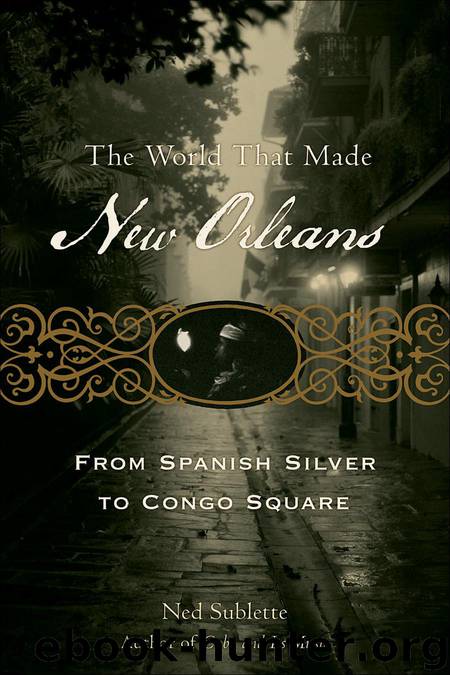
The World That Made New Orleans by Ned Sublette
Author:Ned Sublette
Language: eng
Format: mobi
Publisher: Chicago Review Press
Published: 2008-02-14T21:00:00+00:00
Not content with introducing post-revolutionary Francophone Philadelphia to the concept of vodou, Moreau de St.-Méry described another dance:
[The Vaudoux] is nothing, if we compare it to Dance of Don Pèdre, another black dance, known . . . since 1768. Don Pèdre was the name of a negro of Spanish origin, from the Petit-Goave section, who by his bold character and certain superstitious practices had acquired, among the negroes, such a great reputation that he was denounced to justice as a leader of alarming projects.
The dance that bears his name consists, like the Vaudoux, of extremely vigorous movements of the head and shoulders; but this agitation is extremely violent, and to heighten it further, the blacks drink tafia [eau-de-vie] mixed with finely ground gunpowder.15 The effect of this drink, driven and augmented by their movements, has a great influence over their entire being, so that they enter into a frenzy, with real convulsions. They dance seized with horrible contortions, they dance until they fall into a kind of epilepsy that knocks them down, in a state resembling approaching death.
It was necessary to prohibit severely the dance of Don Pèdre, because it caused great disorders and awakened ideas contrary to public peace. Maybe through electrical effect, the spectators themselves partook of this inebriation, and instead of ceasing their chants when the frenzy breaks out, they would redouble the volume of their voices, push the tempo, and accelerate the crisis in which to a degree they participate. How bizarre is man! In what excesses does he seek pleasure!16
Moreau could only see this in hedonistic terms: pleasure seeking. But he gives us a full description of violent spirit possession and a mention of Don Pedro, who is well known in Haitian folklore today. The two best-known branches (there are others) of contemporary vodou are rara (from Arada) and petro (or petwo). The latter’s rites are generally more violent and unpredictable than the former; according to tradition, its name comes from the name Don Pedro. Some writers have seen in Boukman’s black-pig ceremony the outline of a petro ritual.
Moreau describes yet another dance, the chica, which he ascribes to the Congos of Saint-Domingue, noting that it was performed throughout the Antilles and the Spanish American continent. This is, then, a late eighteenth-century description of a transnational dance that developed in different ways in different countries. Some variant of it would very likely have been danced in black New Orleans. A sexually mimetic pursuit-and-capture dance, Moreau’s description sounds like the dance that became known as guaguancó in Cuba and in Brazil as the belly-to-belly umbigada. Moreau found it arousing. A modern reader may be amused by the euphemism the “lower part of the kidneys”:
The art of the female dancer, who holds the corners of a handkerchief or the two borders of her apron, consists mainly in agitating the lower part of the kidneys, while keeping the rest of the body strictly immobilized. A male dancer approaches while she is in motion, and throws himself at her
Download
This site does not store any files on its server. We only index and link to content provided by other sites. Please contact the content providers to delete copyright contents if any and email us, we'll remove relevant links or contents immediately.
| Africa | Americas |
| Arctic & Antarctica | Asia |
| Australia & Oceania | Europe |
| Middle East | Russia |
| United States | World |
| Ancient Civilizations | Military |
| Historical Study & Educational Resources |
Cat's cradle by Kurt Vonnegut(15380)
Pimp by Iceberg Slim(14535)
4 3 2 1: A Novel by Paul Auster(12413)
Underground: A Human History of the Worlds Beneath Our Feet by Will Hunt(12106)
The Radium Girls by Kate Moore(12042)
Wiseguy by Nicholas Pileggi(5800)
The Fire Next Time by James Baldwin(5458)
Perfect Rhythm by Jae(5419)
American History Stories, Volume III (Yesterday's Classics) by Pratt Mara L(5316)
Paper Towns by Green John(5201)
Pale Blue Dot by Carl Sagan(5019)
A Higher Loyalty: Truth, Lies, and Leadership by James Comey(4974)
The Mayflower and the Pilgrims' New World by Nathaniel Philbrick(4511)
The Doomsday Machine by Daniel Ellsberg(4497)
Killers of the Flower Moon: The Osage Murders and the Birth of the FBI by David Grann(4454)
The Sympathizer by Viet Thanh Nguyen(4403)
Too Much and Not the Mood by Durga Chew-Bose(4359)
The Borden Murders by Sarah Miller(4336)
Sticky Fingers by Joe Hagan(4209)
